
A Little Community Guitar History
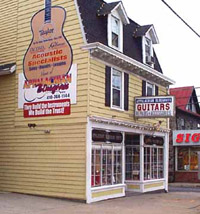 |
In the early 90’s I began teaching guitar professionally through two fine acoustic music stores in the Baltimore area: Baltimore Bluegrass, Inc. (now defunct) and Appalachian Bluegrass Shoppe (still going strong, seen to the right). What I learned through teaching one student after another in half-hour slots for several hours a day was this:
- Most of my students had no place beyond their living room walls for making music.
- If they did have the rare opportunity to jam with others they were often unprepared to do so emotionally, technically or in terms of the repertoire they knew.
This, in my view, went a long way toward explaining why most people stagnated or dropped the instrument entirely for long periods. It may be satisfying to get "better" at something for a little while, but if you only share what you are learning with your spouse and your goldfish, well, who cares? Your spouse can only listen so much and most goldfish just aren't that discerning.
Much to my chagrin, I had to admit that not only was I doing very little to help people out of this rut, I was actually digging them in deeper by teaching material that was appropriate for their isolated circumstance: solo fingerstyle pieces, popular singer-songwriter material, etc. Great stuff for performing or playing alone, but not the kind of material that lends itself particularly well to playing with others at a jam.
The more I thought about it, the more barriers I saw standing between your average adult guitarist and his or her desire for satisfying musical connections with others. Some of these are cultural barriers that affect everyone while others are more specifically related to guitar. To name a few:
- We're busy. Really busy.
- We're increasingly connected through various media, but increasingly disconnected in the flesh. "Bowling alone", anyone?
- Once upon a time, every community had its local music that constituted a cultural commons shared by all. For most of us, though, this is ancient history. We now all have easy access to an incredible diversity of music. Wonderful as this may be, it makes it increasingly unlikely that two musicians - especially guitarists - who happen to share the same turf are also going to share musical tastes, experiences and skills.
- The vast majority of the music we are exposed to is intended primarily for performance, not for community music making. The styles of music that do lend themselves really well to informal jamming exist on the margins of the music industry and most folks never really get turned on to them.
- Unlike, say, your average saxophone player, most guitarists pick up the instrument very casually, often without the benefit of instruction. But being casual learners does not prepare us for casual jamming. Quite the contrary. If you've been "doing your own thing" for years there's a pretty good chance that's all you can do and lord help you if a new situation - like a jam - requires that you stray from your routine.
- There are more guitartists than players of any other instrument, so at jams of all sorts we often run into the "too many guitarists" phenomenon.
So at some point the question naturally arose, what would my teaching practice look like if I were to orient it toward helping people play together rather than alone? In other words, how could I - or any teacher - knock down a few of these barriers? Since that time, I have been experimenting with answers to that question by offering group instruction in a variety of different formats and institutional settings. Here's a rough timeline:
- 1995 - 1999 The Appalachian Institute | Appalachian Bluegrass Shoppe | Baltimore
- 2000 - 2005 The Pioneer Valley Acoustic Guitar Network | Self-Produced | MA
- 2003 - 2006 Group instruction for non-music majors | Western New England College
- 2005 - 2006 The Community Guitar Program | Northampton Community Music Center
- 2006 - present The Community Guitar Program | Self-Produced
 |
At the time I'm writing this (fall 2013) we have 6 Community Guitar classes going with between 50 - 60 active participants at any point in time. The most exciting development in recent years has been the amount of jamming that goes on outside of class. Some of these gatherings are larger, organized affairs, but others are just a couple friends getting together to pick a few tunes. Either way, that's ultimately what Community Guitar is all about. The best way to get in on that action is to contact me and join a study group at a level that suits you best. Do it, and help write the next chapter of our history.

All Community Guitar Resources text & material © 2006 Andrew Lawrence